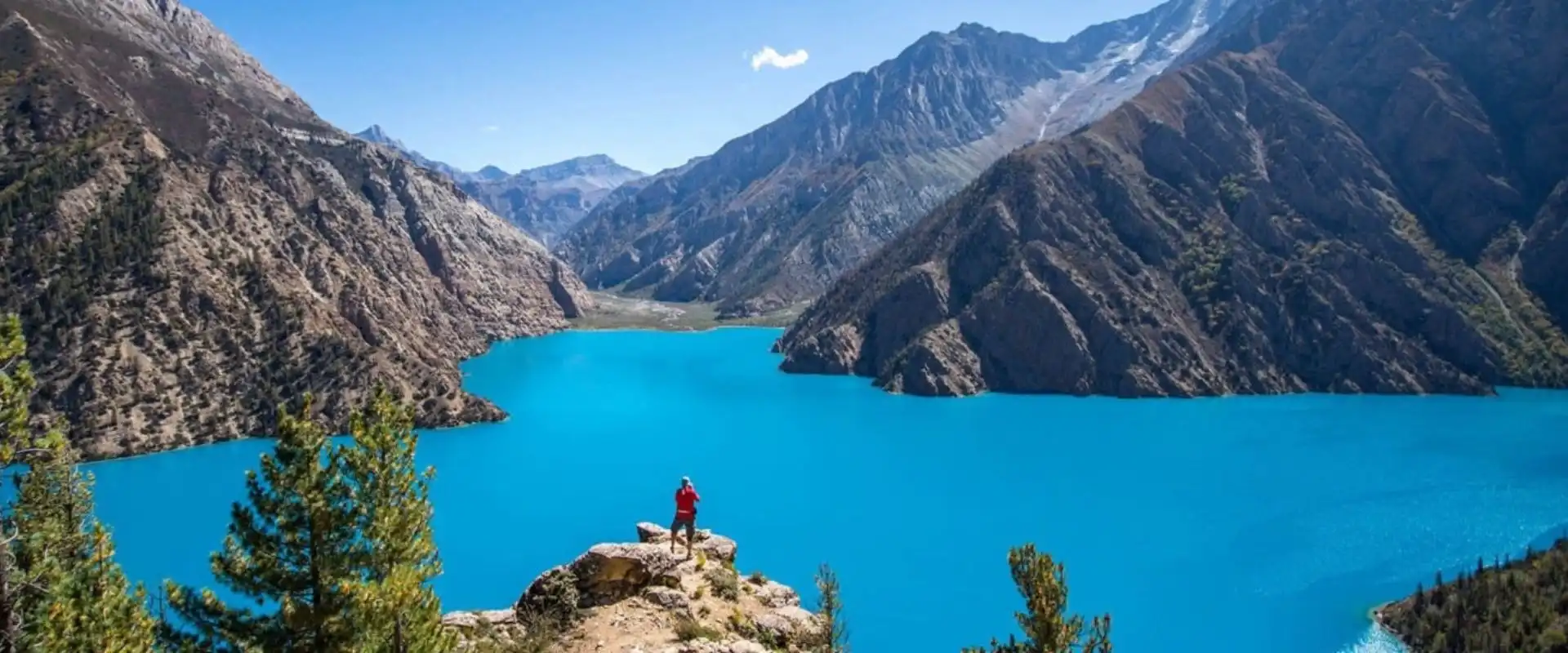
Dolpo is one of the most remote and least visited regions in Nepal. It lies in the rain shadow of the Himalayas in western Nepal, near the Tibetan border. Road access is still very limited. A road from the Mustang side is under construction, and some villages now have rough motorable tracks where jeeps or motorbikes can be arranged on request. Most villages are still linked by trails and high passes, and life still follows Tibetan Buddhist and Bon traditions.
Trekkers come to Dolpo for Shey Phoksundo Lake, ancient monasteries, dry Trans-Himalayan landscapes and the chance to see snow leopards. If you want a trek that feels like a real expedition, Dolpo is hard to beat.
Dolpo is the upper part of Dolpa District. It is a high-altitude, semi-arid region that sits behind the Dhaulagiri range, so it receives far less monsoon rain than most of Nepal. The landscape is closer to the Tibetan Plateau than to the green hills most visitors expect.
Dolpo is usually split into two areas:
The Dolpo-pa people live in valleys such as Dho Tarap, Saldang (Nankhong), Tinje and Chharka. They raise yaks and goats, grow barley and potatoes, and follow Bon and Tibetan Buddhist traditions. Many families once made a living on the trans-Himalayan salt trade with Tibet.
Phoksundo, at about 3,611 m, is Nepal's deepest lake. Its turquoise water, red cliffs and the 167 m Phoksundo waterfall make it the highlight of Lower Dolpo. The nearby village of Ringmo has Bon-style chortens, mani walls and an old gompa.
Nepal's largest national park covers about 3,555 km². It protects snow leopards, blue sheep, Himalayan tahr, musk deer and a rich bird life, and it spans forest, alpine desert and high Himalaya.
Shey Gompa (about 4,500 m) is an 11th-century monastery of the Kagyu school. It is a pilgrimage site where Buddhists and Bon followers walk around Crystal Mountain. Peter Matthiessen's book The Snow Leopard made this place famous.
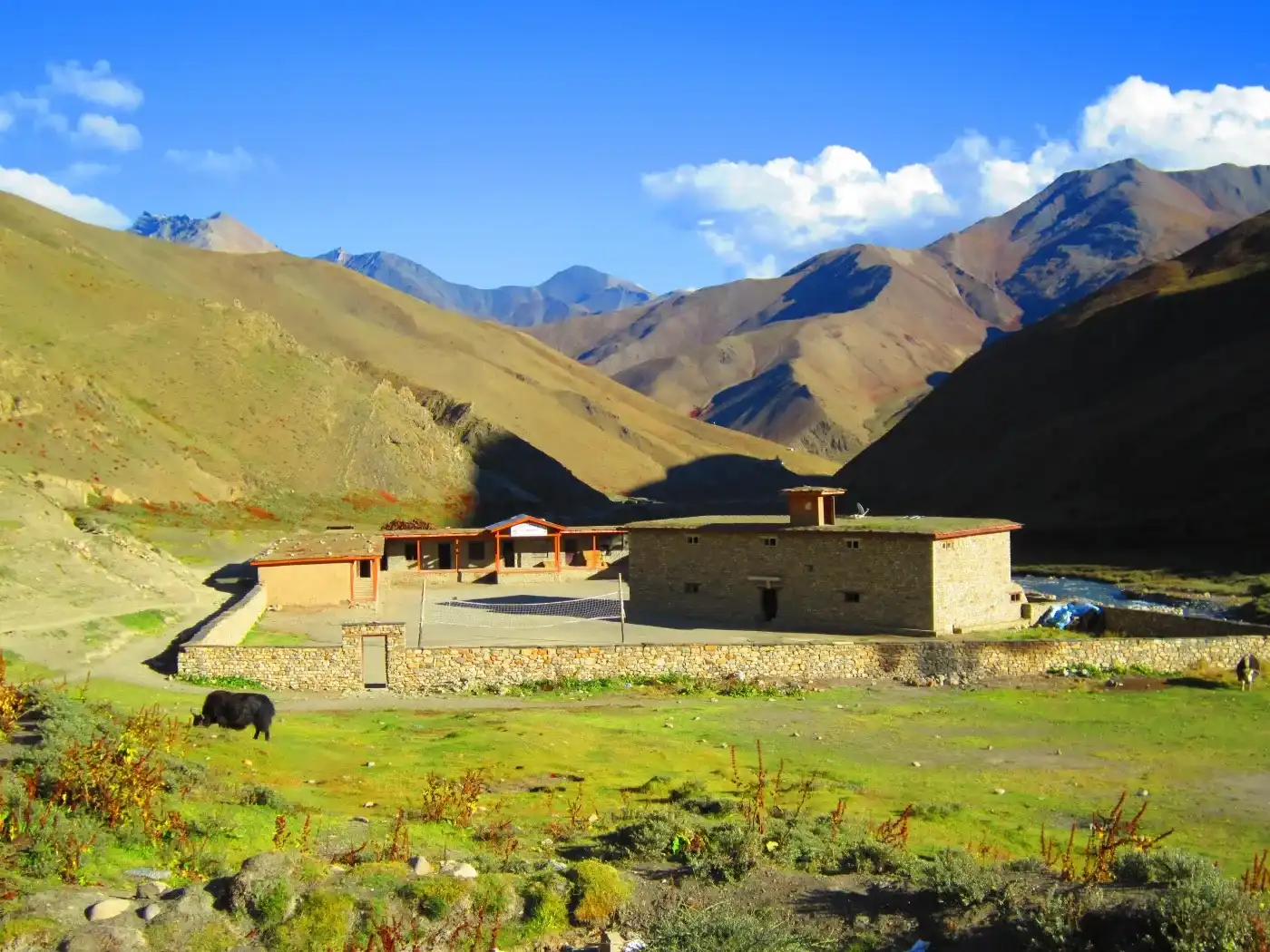
Dho Tarap sits at about 4,000 m and is one of the highest permanently inhabited valleys in Nepal. It is a wide, open valley with stone houses, barley fields and both Buddhist and Bon monasteries.
These villages in the northern part of Upper Dolpo have some of the oldest monasteries in the region. They give a close view of traditional Dolpo life, far from any road.
The Upper Dolpo circuit crosses passes of about 5,070 m to 5,360 m. They are the toughest sections of the trek and give wide views of Dhaulagiri, Kanjiroba and the Tibetan plateau.
The fastest and most convenient trek starts with flights from Kathmandu, as follows.
Tip: Flights to Juphal are often delayed by weather. Keep 1–2 spare days at the start and end of your trip, especially if you have an international flight to catch.
Because of the rain shadow, Dolpo has a different season from the rest of Nepal.
| Seasion | Conditions | Verdict |
|---|---|---|
| Spring (March–May) | Lower Dolpo is clear and mild. Passes in Upper Dolpo may still hold snow until mid-May. | Good for Lower Dolpo; Upper Dolpo from mid-May |
| Summer (June–August) | Much drier than the rest of Nepal. Warm days, green valleys, wildflowers. Some rain in lower areas and flight delays are possible. | Best for Upper Dolpo |
| Autumn (September–November) | Clear skies, stable weather, cold nights at altitude. | Excellent; busiest season |
| Winter (December–February) | Very cold, heavy snow, high passes closed. | Not recommended |
Best overall: mid-May to mid-October for Upper Dolpo, and March to November for Lower Dolpo.
The route varies by agency and season. A typical outline is:
Our team will fine-tune the itinerary to match your fitness, season and time.
| Permit | Needed for | Fee (approx.) | How to get it |
|---|---|---|---|
| Shey Phoksundo National Park entry | Lower and Upper Dolpo | NPR 3,000 per person | Kathmandu (Department of National Parks) or park entrance |
| Lower Dolpo Restricted Area Permit | Passing through Lower Dolpo to reach Upper Dolpo | USD 20 per person for the first week, then USD 5 per person per week | Registered agency, from Kathmandu |
| Upper Dolpo Restricted Area Permit | Upper Dolpo circuit | USD 50 per person per day, or equivalent convertible currency (USD 500 for 10 days) | Registered agency only, from Kathmandu |
Lower Dolpo restricted area covers:
Upper Dolpo restricted area covers:
Camping (Upper Dolpo): Most Upper Dolpo treks are fully supported camping expeditions. A crew carries tents, food and gear with pack animals, and the cook prepares hot meals.
Basic lodges (Lower Dolpo): Simple tea houses are available around Phoksundo Lake and the lower trail, with shared facilities.
Food: Expect dal bhat, thukpa, tsampa (roasted barley flour), potatoes, noodles and butter tea. On camping treks, the kitchen team cooks fresh meals each day.
Culture: Bon and Tibetan Buddhist practice is part of everyday life. You will see prayer flags, mani walls, chortens, stone houses and yak caravans. Please walk clockwise around religious sites, ask before taking photos of people, and dress modestly.
Dolpo is also known worldwide through the film Himalaya (also released as Caravan), which was shot in the region.
Dolpo is not a trek you can improvise. Permits, flights, camping logistics and acclimatization all need to be right. Ghumnajaau, a Nepal-based travel company operating since 2013, handles permits, licensed guides, porters, cooks, flights and emergency planning so you can focus on the trail.
Ready to plan your Dolpo trek? Contact Ghumnajaau for a custom itinerary and a clear quote. Find your itinerary here.
How difficult is the Dolpo trek?
Upper Dolpo is one of the hardest treks in Nepal because of its length, remoteness and passes above 5,000 m. Lower Dolpo (Phoksundo Lake) is much easier but still needs good fitness.
Do I need a permit for Dolpo?
Yes. Lower Dolpo needs the national park permit. Upper Dolpo also needs a restricted area permit, arranged through a registered agency.
Can I trek in Dolpo alone?
Not independently. Upper Dolpo requires a registered agency and a licensed guide.
How long is the Upper Dolpo trek?
Most itineraries take 20–28 days, including flights and spare days.
What is the best month for Dolpo?
May–June and September–October are the most popular months. June to August is also good for Upper Dolpo because of the rain shadow
Still have questions about Dolpo? Talk to Ghumnajaau for permits, guides and a custom itinerary. Plan your Dolpo trek.


We create unforgettable trips, customized for your group.